Some of the world’s most influential leaders from the engineering, construction and infrastructure sectors take time out to discuss the key challenges facing their industry.
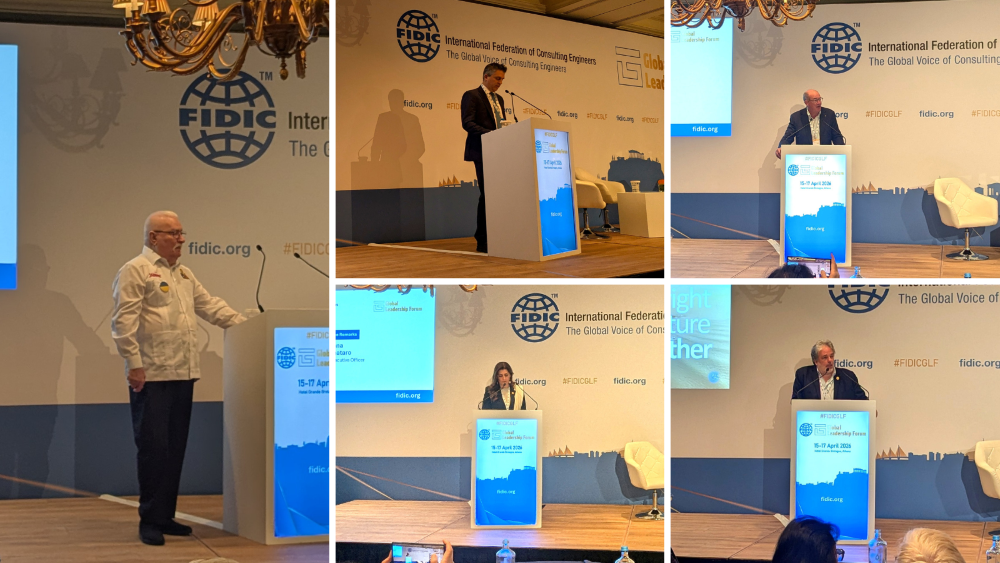
The fourth annual Global Leadership Forum event, organised by the International Federation of Consulting Engineers (FIDIC), kicked off in Athens on 16 April 2026 with 100 of the world’s infrastructure leaders in attendance to discuss and address some of the key challenges facing the industry and the world.
Opening the event, sponsored this year by Bentley Systems (platinum sponsor) and Autodesk (gold sponsor), FIDIC’s CEO Susanna Zammataro, said that the forum provided a unique opportunity to discuss some of the key challenges facing the infrastructure sector, but also importantly, the real opportunities that exist for the industry.
President of FIDIC Alfredo Ingletti highlighted the key role of engineers in the infrastructure industry and the importance of FIDIC’s role in bringing leaders together. “The first priority of infrastructure is to connect people and to improve their quality of life,” he said. “After all, infrastructure is what nature cannot do – it changes the way that we live. Within that, FIDIC has never been more essential to provide a common platform for the industry’s leaders to gather at events like this and engineer a bright future together,” said Ingletti.
Bill Cox, chair of the Global Leadership Forum advisory board, said that the concept of permacrisis was especially apposite given current world events. He acknowledged the efforts of those present to attend at a time of time of turbulence and volatility. “It’s often too easy to say that you don’t have time or that it will not matter – it does!”
Cox highlighted the important role of the Global Leadership Forum. “It does what it says on the tin – we bring together the top leaders globally to share ideas, challenge each other, come away with new perspectives and approaches as well as new partnerships and ideas,” he said. “The forum also recognises the unique role that leaders have, which is often lonely, unforgiving, requiring courage, integrity, resilience and the ability to say no when the easy answer is yes, and, conversely, the strength to say yes when no is the easy out,” Cox said.
Welcoming attendees to his country, Christos Dimas, the minister of infrastructure and transport of the Government of the Hellenic Republic, said that Greece had been implementing a network of new infrastructure to help develop the country’s role as a key international strategic transport hub, connecting regional networks with global value chains. Significant investments had been made, the minister said, and infrastructure was at the core of his country’s ambitious plans with €2.36bn earmarked for infrastructure projects in 2026 alone.
The minister highlighted the importance of European transport corridors, noting that Greece participates in two key routes – the Baltic Sea-Black Sea-Aegean corridor and the Western Balkans-Eastern Mediterranean corridor – which form the backbone of the country’s long-term planning, particularly important in a shifting geopolitical environment.
“My country and my department is well aware of the importance of sound planning and design and so the expertise of engineers and the work of FIDIC’s membership is very important to what we are trying to achieve,” the minister said. “The same applies to renovations of schools and hospitals where the expertise of consultancy firms is absolutely vital along with the promotion of new production and working methods,” Dimas said.
Keynote speaker Lech Wałęsa, the former president of Poland and a Nobel Prize Laureate, highlighted the concept of what happens when old institutions and established ways of doing things become obsolete. “In Poland, we saw that the current arrangements that we were facing gave no prospect of reform, so they had to be changed. We said that we needed to find peaceful arguments and strategies to make change and we destroyed an old order to build something new,” Wałęsa said. It was important to remember and learn from the lessons of the past. “Everything that we do in the world today has to face up to what we have done before, including the mistakes that have been made – especially the political ones,” he said.
Wałęsa praised the impact of the work of the infrastructure sector. “Your industry has a key role to play in the world because the work that you do changes that world and politicians could not do without it. Your best solutions to address and solve the world’s problems can change our world, but of course, the same politicians can wreck your best plans,” he said. That was why people who were skilled in figuring out technical and practical solutions should get involved in politics, he said, urging his audience to engage more directly with the political process in their countries.
He told his audience: “Successful people like you don’t want to get involved in politics and that means that we get the politicians we currently have, like the populists who don’t have solutions and answers to the challenges and problems facing the world. We need the people who know how to build to help us build the better world we want to see,” he said. Referring to FIDIC’s call to “engineer a bright future together”, Wałęsa said: “Being together is important, especially when we have something to ‘be together’ about.”