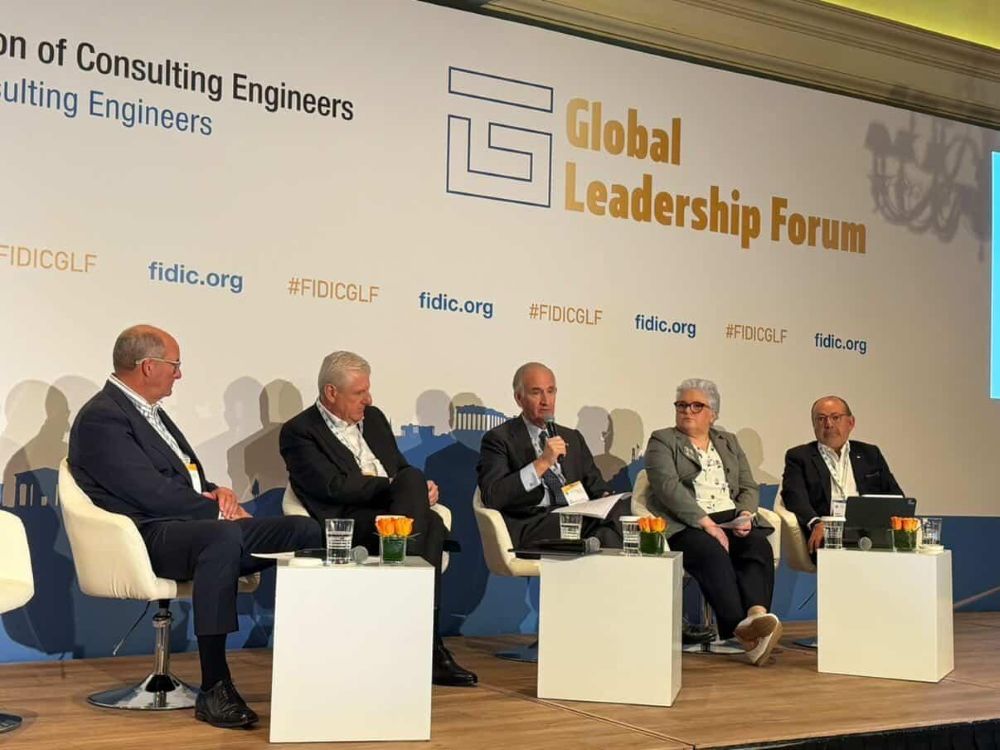
As global political and economic headwinds intensify, industry leaders try to make sense of uncertainty and map a way forward.
“You’ll need a stiff drink and to sit down before you start reading some of latest reports coming out of the International Monetary Fund and the World Bank,” said Bill Cox, chair of the Global Leadership Forum advisory board, as he opened a panel session on Navigating global geopolitical challenges across infrastructure at FIDIC’s annual Global Leadership Forum event in Athens on 16 April 2026.
Ian Edwards, president and CEO of AtkinsRéalis, highlighted the growing importance of energy security in national security and the key role of nuclear within that. His company had a real stake in that as a nuclear OEM (original equipment manufacturer). With over 70 years of experience, AtkinsRéalis owns the intellectual property for the CANDU pressurised heavy-water reactors, which are used in over 30 sites globally.
Luis Villarroya, president of EPTISA, said that geopolitics wasn’t to the fore in business leaders’ minds to the extent that it is today. “There has been a massive change in the world in recent years and a total shift in the priorities of global governments,” he said. Engineering firms need to be aware of these changes and be able to navigate them in a way that underlines their value to society, said Villarroya.
Alaleh Motamedi, head of procurement at the European Investment Bank, said that her organisation has lived with geopolitics for many years and this has forced the EIB to adapt its work and move into new areas to keep pace. She said that the bank wanted to move towards a more strategic type of procurement which would mean more partnerships and alliances with organisations like FIDIC.
The current critical situation in the Middle East was highlighted by Bisher Jardaneh, executive chairman of AJi Group. He said that spending priorities were shifting as a result and new pressures were coming to bear. “Resilience is replacing efficiency and capital is moving to new areas as countries look to safeguard themselves against global headwinds and uncertainties. “Many of today’s defining challenges are fundamentally systems problems, which engineers can solve, but engineers remain underrepresented in civic and political spheres,” Jardaneh said.
Addressing Bill Cox’s question to panellists “in an age of alternate media, misinformation and disinformation where do you get your facts, information and intelligence?” Ian Edwards said: “As leaders we have to form a view on the world around us. Interactions with different people, including at forums like this one, give us the opportunity to immerse ourselves in information and knowledge that we can then use in our companies.” Bisher Jardaneh said that there were many sources of information to tap into, but he strongly advised the audience “to ignore social media and the politicians!” Luis Villarroya said that, more than ever, it was important for companies to pay attention to people’s wellbeing as this would inevitably be affected by ongoing geopolitical uncertainties facing the world. “Our people experience the same world as we do, but people also experience the world differently,” he said.
Notwithstanding the serious challenges facing the industry from the current geopolitical situation, many of the panellists in the session stressed that there were strong business opportunities from the evolving world situation too. The increasing focus on defence and resilience in particular would increase global demand for the work of the infrastructure sector, which is uniquely placed to provide the solutions the world needs.