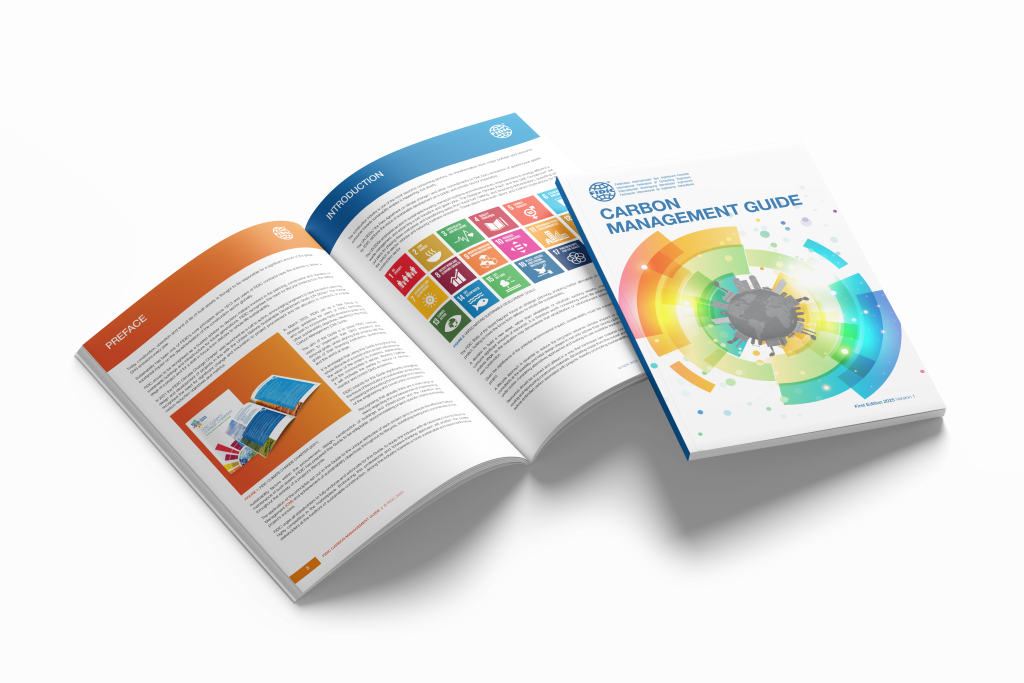
A new guide from the International Federation of Consulting Engineers (FIDIC) offers a roadmap on how to integrate carbon management into its construction contracts.
A new FIDIC guide to integrate carbon management into FIDIC contracts has been launched and offers users practical information and guidance in this crucial area. The guide is set to play a key role in supporting the adoption of carbon management practices across global infrastructure projects.
The new guide, which is designed to help the global infrastructure and construction sectors embed carbon-conscious thinking into every stage of a project’s lifecycle, underscores FIDIC’s longstanding commitment to sustainability and decarbonisation and builds on the FIDIC Climate Change Charter, launched in 2021, which sets out in basic, initial terms, how to address climate mitigation, adaptation and resilience in the built and natural environment.
Launching the FIDIC Carbon Management Guide in London this month, FIDIC contracts committee member Adriana Spassova praised the hard work of the task group members who helped in the guide’s production under the direction of FIDIC’s contracts committee. “Publication of this guide is a key development for FIDIC and underlines the importance of all stakeholders on projects collaborating to improve the carbon balance sheet,” she said.
The guide strongly advocates that applying carbon management best practices throughout a project’s lifecycle helps participants to adopt a realistic approach and can also provide the tools to reward ambition. The FIDIC Carbon Management Principles are also referenced in the new guide, which provide an ethical and practical foundation for effective and efficient decarbonisation detailed below.
- Making the carbon emissions budget a mandatory evaluation criterion transforms procurement into a driver of innovation.
- All stakeholders working together to improve the project’s carbon balance sheet creates a common goal.
- Prioritising the reduction of greenhouse gas (GHG) emissions rather than the use of offsetting focuses on change now.
- Establishing unambiguous calculation methodologies delivers fair competition and contractual certainty.
- Maintaining employer responsibility for GHGs removal, rather than transferring risks inappropriately, ensures clarity and certainty.
- Recognising the need for continuous improvement helps drive industry transformation forward towards decarbonisation.
Significantly, the FIDIC Carbon Management Guide redefines stakeholder roles and responsibilities. Employers become GHG stewards owning the project’s carbon balance sheet. Financing institutions gain tools to drive sustainability through procurement requirements. Contractors compete on GHG emissions efficiency alongside cost and quality and the entire supply chain becomes accountable for transparent GHG emissions reporting and continuous improvement.
FIDIC hopes that the new guide will be implemented across all of the 170 countries that use FIDIC contracts, helping to make a significant difference on global infrastructure projects. The new guide, which was distributed to attendees at the recent FIDIC International Contract Users Conference in London as a special pre-release edition, will be available for purchase from the FIDIC Bookshop at the end of December (electronic copies) and January (for hardcopies).
Available now free of charge from the FIDIC website is a digital Q&A to support the FIDIC Carbon Management Guide.